

.png)
Most facility management conversations start with maintenance, the broken pump, the chiller fault, the overdue work order. It's the visible, urgent half of the job. But maintenance only answers one question: is the building still working?
The harder question is the building working well, belongs to operations. Energy consumption trending 15% above baseline. HVAC schedules running on winter setpoints in April. A vendor contract renewed for the third year without a single performance review. These aren't maintenance failures. They're operations failures. And they're often more expensive because no one is tracking them.
Operations and maintenance in facility management is the combined discipline that covers both - keeping building systems running (maintenance) and keeping them running at their best (operations). Most FM teams have built strong processes for the first half. The second half is where the gap lives, and where the biggest portfolio-scale value sits untouched.
What Is Operations and Maintenance in Facility Management?
Operations and maintenance often shortened to O&M is the discipline of running a building's systems day to day and keeping them functioning over time. It covers every activity from adjusting an HVAC setpoint to replacing a chiller compressor, from reviewing a monthly energy report to closing a corrective work order.
The two halves serve different purposes.
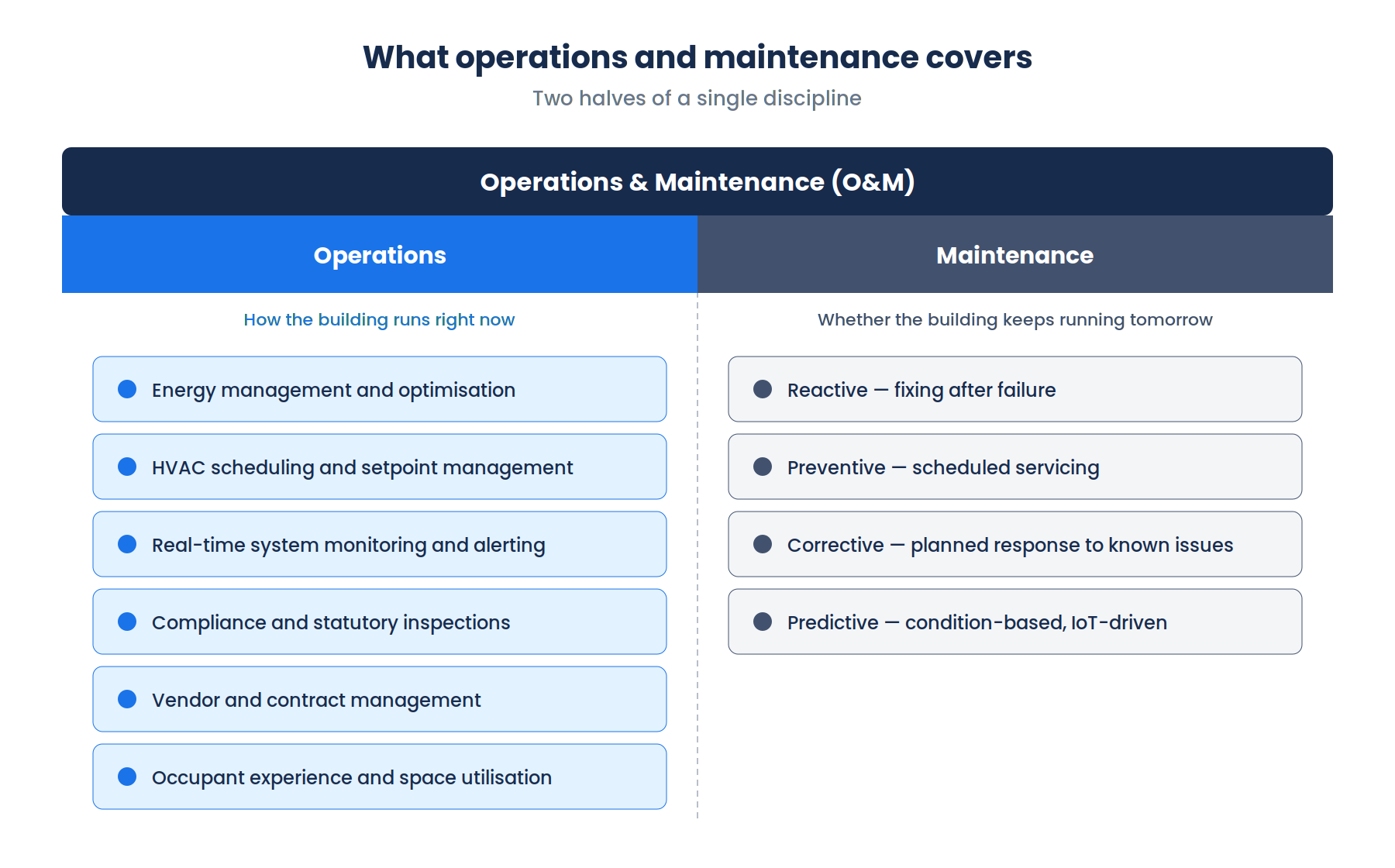
Operations is about performance. It's the active management of how a building runs right now - energy consumption, HVAC scheduling, real-time system monitoring, compliance tracking, vendor coordination, and occupant comfort. An operations failure doesn't trigger an alarm. It shows up in an electricity bill three months later, or in a tenant satisfaction survey at lease renewal.
Maintenance is about preservation. It's the work done to keep assets functioning preventive servicing, corrective repairs, predictive interventions, and reactive fixes when equipment fails. Maintenance failures are loud. A tripped chiller or a flooded plant room demands immediate attention. For a detailed breakdown of how the maintenance side works, see our guide to repair and maintenance in facility management.
The distinction matters because most FM teams are structurally stronger on maintenance than on operations. The work order system exists. The PM schedule is running. Technicians know what to fix. But the operations side are we consuming more energy than we should be, are vendor contracts delivering value, is every building in the portfolio running to the same standard often has no system, no owner, and no KPIs.
Mature FM teams treat operations and maintenance as two halves of a single discipline, not two separate departments. The technology underneath should do the same.
What Does O&M Cover in a Commercial Facility?
A commercial building is a stack of interdependent systems mechanical, electrical, plumbing, fire safety, vertical transport, IT infrastructure, each with its own performance parameters and maintenance requirements. O&M covers all of them. But the scope extends well beyond keeping equipment running.
The Operations Side
This is the half most FM teams underinvest in. It includes:
Energy management and optimisation - Monitoring consumption across meters, identifying waste, adjusting schedules and setpoints to reduce cost without compromising occupant comfort. In a 20-building portfolio, even a 5% improvement in energy efficiency translates to lakhs saved annually.
HVAC scheduling and setpoint management - Ensuring cooling and heating systems run to the right parameters at the right times not running on winter schedules in summer, not cooling empty floors at full capacity on weekends.
Real-time system monitoring and alerting - Live visibility into how building systems are performing right now, not what a technician reported last Tuesday. Temperature deviations, power anomalies, equipment running outside spec flagged as they happen, not discovered during a walkthrough.
Compliance and statutory inspections - Fire safety certifications, electrical safety audits, elevator inspections, environmental clearances. Every jurisdiction has its own calendar. Missing one isn't an inconvenience, it's a legal and insurance liability.
Vendor and contract management - Tracking vendor performance against SLAs, managing AMC renewals, benchmarking costs across sites. Without centralised data, vendor contracts get renewed on autopilot and overspend becomes invisible.
Occupant experience and space utilisation - Indoor air quality, thermal comfort, lighting levels, meeting room availability. The tenant-facing side of operations that directly influences lease renewals and workplace productivity.
The Maintenance Side
The maintenance side of O&M covers the four modes of keeping assets functional - reactive, preventive, corrective, and predictive maintenance. Rather than repeating what's already covered in depth, here's the short version:
Reactive - fixing equipment after failure. Expensive, disruptive, sometimes unavoidable for low-criticality assets.
Preventive - scheduled, time-based servicing to prevent failure before it happens. The workhorse of mature FM operations.
Corrective - planned repairs in response to a known issue, executed on a schedule rather than in emergency mode.
Predictive - IoT-driven, condition-based maintenance triggered by real-time sensor data rather than a calendar.
Each mode carries different cost, risk, and resource implications. How a facilities team balances the mix across these four modes largely determines its overall maintenance maturity.
Why O&M Matters More at Portfolio Scale
A single building with a good facility manager can run well on experience and familiarity. The engineer knows the chiller's quirks. The security team knows which fire panel throws false alarms. The vendor shows up because the relationship is personal.
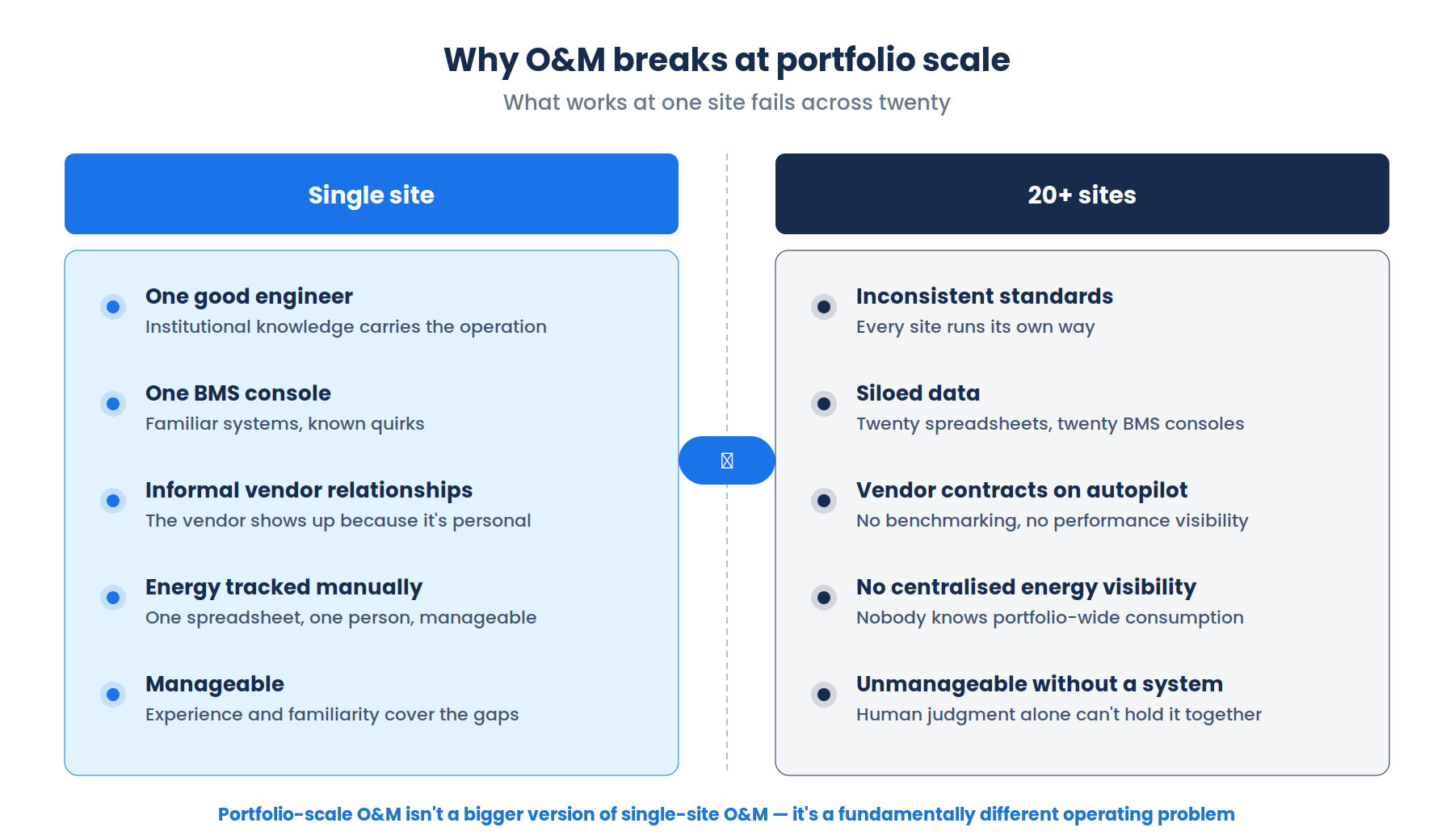
Scale that to twenty buildings across four cities and every one of those informal systems breaks down.
Operating standards become inconsistent - Site A runs HVAC setpoints at 23°C. Site B runs at 21°C. No one has compared energy consumption between the two to ask why. Every building operates as its own island, with its own logic, its own vendors, and its own definition of "well-maintained."
Visibility disappears - No single person can tell you, today, how much energy the portfolio consumed this month versus last month. Or which sites have overdue statutory inspections. Or which assets across all locations are approaching end-of-life. The data exists, but it's locked in twenty separate spreadsheets, BMS consoles, and email threads.
Reactive operations become the default - Without centralised monitoring, the only signal that something is wrong is a complaint or a breakdown. By the time it surfaces, the cost has already been incurred, in wasted energy, in tenant dissatisfaction, in emergency repair spend.
Vendor management becomes unmanageable - Fifteen AMC vendors across twenty sites, each with different contract terms, renewal dates, and performance standards. No benchmarking. No visibility into whether Site 12's HVAC vendor is delivering the same quality as Site 3's. Contracts renew on autopilot because no one has the aggregated data to challenge them.
The pattern is always the same: what works through human judgment at one site requires systemic infrastructure at ten. O&M at portfolio scale isn't a bigger version of O&M at a single site. It's a fundamentally different operating problem, and it requires a fundamentally different technology layer to solve.
The Cost of Poor O&M (And Where the Money Actually Goes)
Poor O&M doesn't announce itself with a single invoice. It spreads across budget lines - energy bills, capex requests, vendor renewals, tenant retention metrics - making it hard to see and even harder to quantify. The money leaves, but no single report shows where it went.
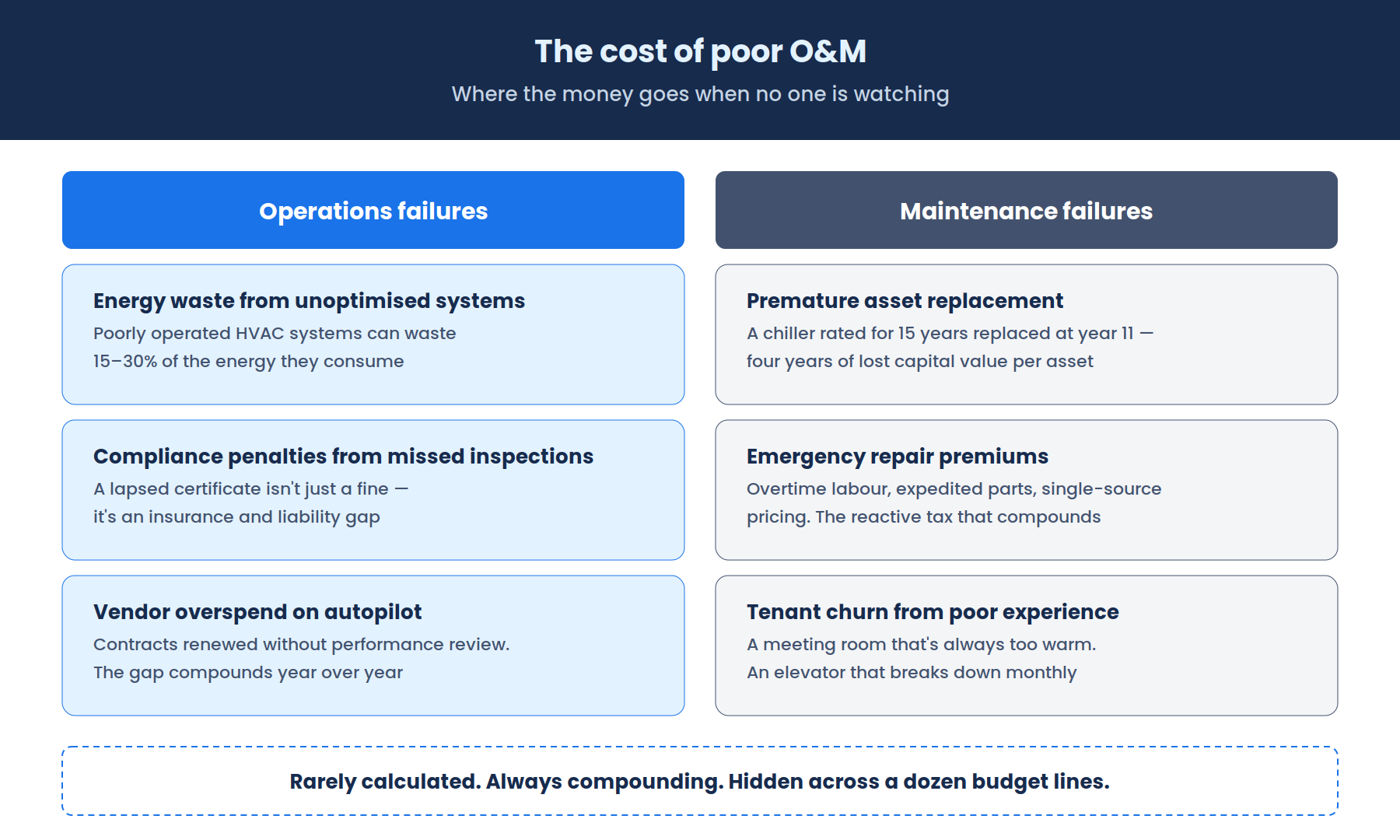
On the operations side:
Energy waste from unoptimised systems - HVAC running at full capacity on half-occupied floors. Cooling on outdated setpoints. Across a portfolio, poorly operated HVAC systems alone can waste 15–30% of the energy they consume.
Compliance penalties from missed inspections - A lapsed fire safety certificate isn't just a fine — it's an insurance gap that dwarfs the cost of the inspection itself.
Vendor overspend on autopilot - Contracts renewed without performance review. AMC rates accepted without cross-site benchmarking. The gap compounds year over year.
On the maintenance side:
Premature asset replacement - A chiller rated for 15 years that gets replaced at year 11 four years of lost capital value, multiplied across every major asset in the portfolio.
Emergency repair premiums - Overtime labour, expedited parts, single-source vendor pricing. The reactive tax that compounds every time a failure isn't anticipated. See Inventory Management in facility management.
Tenant churn from poor experience - A meeting room that's consistently too warm. An elevator that breaks down monthly. These are O&M failures tenants remember at renewal time.
How IQnext Brings Operations and Maintenance Together
The typical multi-site FM setup looks something like this: a BMS for building control at each site, a CMMS for work orders, a separate energy monitoring tool (or no tool at all), and a spreadsheet tracking vendor contracts. Operations data lives in one place. Maintenance data lives in another. Nobody has stitched them together.
That's the gap IQnext is designed to close - not by replacing each tool, but by creating a single platform where both halves of O&M share the same data layer.
Energy and device control, connected to asset health
IQnext manages HVAC scheduling, setpoint control, and real-time energy monitoring on the operations side - while simultaneously tracking asset condition, maintenance history, and work order status on the maintenance side. When a chiller's energy consumption spikes, the platform doesn't just flag the anomaly. It connects that spike to the asset's service history and surfaces whether it's an operational issue (wrong setpoint) or a maintenance issue (degraded compressor). That distinction changes the response entirely.
The closed loop that siloed systems can't create
When energy data, device control, asset health, and work order workflows live in the same platform, the building starts telling you what it needs, whether that's an operational adjustment or a maintenance intervention. That's the difference between managing O&M reactively and managing it intelligently.
Where O&M Becomes a Competitive Advantage
Operations and maintenance in facility management is the discipline that determines whether a building portfolio is a well-run asset or a collection of expensive problems managed one emergency at a time. Most FM teams have built strong processes for the maintenance half - the work orders, the PM schedules, the technician workflows. The operations half - energy, compliance, vendor performance, occupant experience — is where the larger, quieter losses accumulate.
The teams that close that gap won't be the ones with the biggest maintenance budgets. They'll be the ones who stopped treating operations and maintenance as two separate functions and started running them as one connected discipline with one platform, one data layer, and one portfolio-wide view of how their buildings are actually performing.
FAQs
1. What is operations and maintenance in facility management?
Operations and maintenance in facility management is the combined discipline of running building systems at their best (operations) and keeping them functioning over time (maintenance). It covers everything from energy optimisation and compliance tracking to preventive servicing and corrective repairs.
2. What is the difference between operations and maintenance?
Operations is about performance - managing how a building runs right now, including energy, HVAC scheduling, and occupant comfort. Maintenance is about preservation - the preventive, corrective, and predictive work done to keep assets functioning within design specifications.
3. Why does O&M matter more at portfolio scale?
At a single site, O&M can run on institutional knowledge. Across twenty buildings, inconsistent standards, siloed data, no centralised energy visibility, and unmanaged vendor contracts compound into significant avoidable cost. Portfolio-scale O&M requires a unified system, not twenty separate ones.


