

.png)
Walk into any commercial building and you'll see the same paradox. Polished lobbies, premium fit-outs, and behind the scenes, a maintenance operation held together by spreadsheets, WhatsApp groups, and the institutional memory of one or two senior engineers.
A chiller trips on the hottest day of the year. A water leak is discovered three floors below where it started. A fire alarm panel throws an unexplained fault during a tenant audit. Each event triggers the same scramble: who knows this system, who has the part, who can be on-site in the next two hours. The cost of getting it wrong is rarely a single line item. It's measured in compressor lifespan, in SLA breaches, in tenant trust quietly eroding over the course of a lease.
This is the reality of repair and maintenance in facility management today, a discipline that determines whether a building portfolio operates as a high-performance asset or a recurring fire to be put out. And for most operators, the gap between what their R&M function does and what it could do is wider than they realise.
What Is Repair and Maintenance in Facility Management?
Repair and maintenance in facility management covers the full set of activities that keep a building's systems, assets, and infrastructure running safely and efficiently , from a one-hour lighting fix to a three-day chiller overhaul. At portfolio scale, it's the largest recurring operational cost a facilities team manages.
The two terms describe distinct activities. Repair is corrective , restoring an asset after it's already failed. Maintenance is proactive , inspections, cleaning, calibration, and scheduled replacements done before failure.
Mature FM operations treat them as two ends of a single continuum, with the goal of shifting as much work as possible from the repair side to the maintenance side. Every emergency repair is, in effect, a maintenance failure that wasn't caught in time.
The Four Modes of Repair and Maintenance
Not all R&M work is the same. A planned filter replacement and an emergency switchgear repair sit at opposite ends of cost, risk, and operational maturity. Understanding the four modes is what separates a facilities team that reacts to problems from one that manages them.
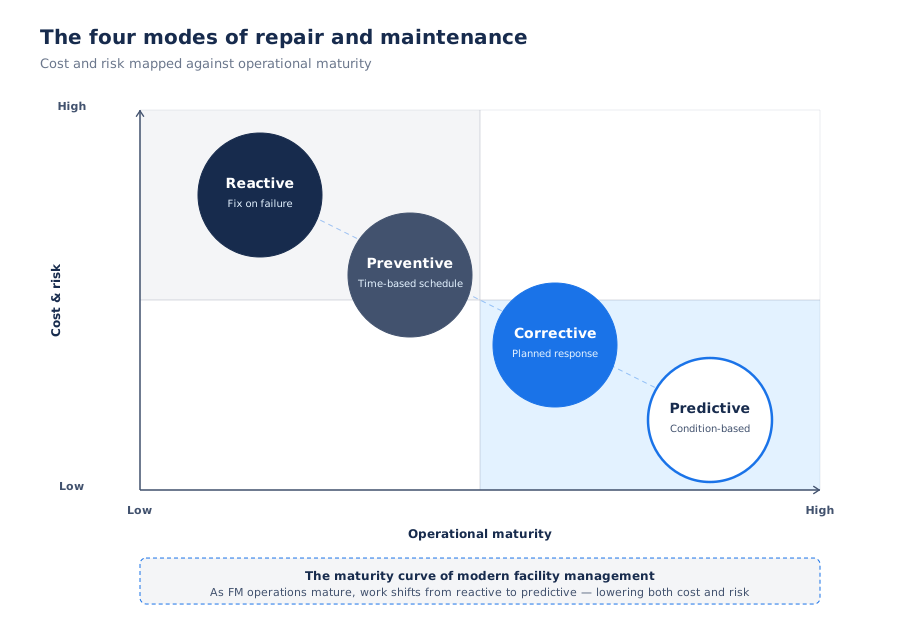
Reactive (Breakdown) Maintenance
Work performed only after an asset has failed. No schedule, no anticipation. For low-criticality assets, this is sometimes the right call , inspecting every light fixture quarterly makes little economic sense. The trouble starts when it becomes the default for critical systems, and emergency repairs, overtime premiums, and lifespan reduction compound into real money.
Most FM operations underestimate how much of their work is genuinely reactive. The honest figure is usually closer to 60–70% than the 30–40% leadership assumes.
Preventive Maintenance
Scheduled, time-based work performed at fixed intervals , quarterly AHU filter changes, annual transformer servicing. By intervening before expected failure windows, you avoid unplanned downtime and extend asset life.
This is the workhorse of mature FM operations, tracked through Planned Maintenance Percentage (PMP). Above 80% signals a well-run operation. Below 50% signals a team in firefighting mode. The limitation: it's calendar-driven, not condition-driven , so it will sometimes service an asset that didn't need attention, and occasionally miss one that failed early.
Corrective Maintenance
The overlooked middle ground. Planned work performed in response to a known issue , a deviation flagged during inspection, a sensor showing unusual behaviour , but executed on a schedule, not in emergency mode. A bearing showing early wear isn't replaced on the spot, but it isn't ignored either. It's slotted into the maintenance schedule before it fails.
Predictive (Condition-Based) Maintenance
The IoT-enabled frontier. Real-time sensor data , vibration signatures, operating temperatures, current draw , replaces fixed schedules. A chiller compressor isn't serviced because six months have passed; it's serviced because vibration analysis shows bearing wear has crossed a threshold.
Predictive maintenance is where the gap between traditional CMMS-only operations and modern IoT-enabled platforms shows up most clearly. The CMMS captures the work order. The IoT layer decides when it should exist.
What Repair and Maintenance Actually Covers in a Commercial Facility
The scope of repair and maintenance in a typical commercial facility is broader than most outside the industry realise. A 500,000 sq. ft. office building is, in operational terms, a stack of interdependent engineering systems , each with its own failure modes, maintenance protocols, regulatory requirements, and skilled labour needs. A facilities team is responsible for keeping all of them running, all of the time.
The major categories of building systems under an FM team's R&M remit include:
HVAC and Chiller Plant
Air handling units, chillers, cooling towers, pumps, ductwork, VAV boxes, and refrigerant systems. Typically the single largest energy consumer in a commercial building and the most maintenance-intensive system on site.
Electrical and Switchgear
Main panels, sub-distribution boards, transformers, capacitor banks, UPS systems, and backup generators. High-criticality, high-consequence , a switchgear failure can take a tower offline in minutes.
Plumbing and Water Systems
Domestic water supply, sewage, drainage, pumps, water treatment plants, and rainwater harvesting infrastructure. Often invisible until a leak makes them very visible.
Fire and Life Safety
Detection panels, sprinkler systems, fire pumps, smoke management, emergency lighting, and public address. Heavily regulated, with mandatory inspection and compliance schedules.
Elevators and Vertical Transport
Passenger and service lifts, escalators. Statutory inspection requirements in most jurisdictions, including India and the UAE.
Building Envelope and Interiors
Façades, glazing, waterproofing, false ceilings, flooring, doors, and finishes. Lower technical intensity but high tenant-visibility.
IT and Low-voltage Infrastructure
Building management systems, access control, CCTV, structured cabling, AV systems. Increasingly central to building operations as facilities digitise.
The scale challenge is obvious: a facilities manager running a single building tracks hundreds of individual assets across these categories. A portfolio operator running 20 buildings is tracking tens of thousands. Manual tracking , spreadsheets, paper checklists, walkie-talkie coordination , stops working long before that scale is reached. What's needed is a system that knows what every asset is, where it is, when it was last serviced, and what's due next.
That's the structural problem the next section gets into , the hidden cost of letting reactive R&M become the default operating mode.
The Hidden Cost of Reactive Repair and Maintenance
When a facilities team operates in reactive mode, the line item on the P&L only shows part of the picture. The invoice for the emergency repair is visible. Everything else it triggers , the cascading operational and financial consequences , is buried in other budgets, other quarters, and other conversations. That's what makes reactive R&M so persistent. It's expensive in ways that don't show up on a single report.
A closer look reveals five cost categories that compound quietly behind every emergency repair.
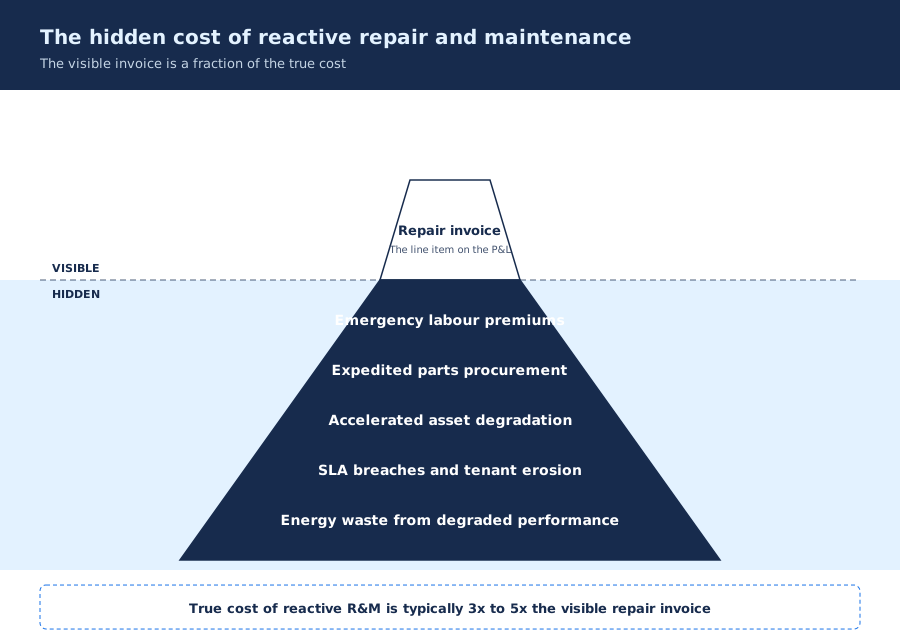
Emergency labour premiums
Reactive repairs rarely respect business hours. Overtime rates, weekend rates, and after-hours call-out charges can run 1.5x to 2.5x standard labour costs. A single critical failure outside working hours can cost more in labour alone than a full quarter of planned maintenance on the same asset.
Expedited parts procurement
When a part isn't in stock and an asset is down, normal procurement rules are suspended. Expedited freight, single-source purchasing, and emergency vendor markups can inflate part costs by 30–50% over standard procurement pricing. The teams that have invested in strong Inventory management in FM avoid this category almost entirely.
Accelerated asset degradation
Running equipment to failure shortens its useful life. A chiller that operates under strain for four days before a seal replacement loses operating hours from its compressor that won't come back. Across a portfolio, this shows up as earlier-than-expected capital replacement cycles , assets that should have lasted 15 years getting replaced at year 11.
SLA breaches and tenant satisfaction erosion
In commercial real estate, SLA penalties are often the visible cost. The less visible cost is the slow erosion of tenant trust , the kind that influences renewal decisions two or three years down the line. A tenant whose office was uncomfortably warm for a full day in July remembers that conversation when their lease comes up.
Energy waste from degraded performance
Equipment running outside its design envelope consumes more energy. A poorly maintained chiller plant can run 10–15% less efficiently than its specification. Across a 20-building portfolio, that difference is measurable in lakhs of rupees of avoidable electricity consumption every month.
Adding these together, the true cost of reactive repair and maintenance is typically 3x to 5x the cost of the visible repair invoice. This is the financial case for shifting work from the repair side of the continuum to the maintenance side , and it's where the technology layer underneath modern FM operations starts to matter.
How IQnext Approaches Repair and Maintenance for Modern Buildings
The shift from reactive to proactive R&M isn't a philosophy problem , it's an infrastructure problem. Most FM teams already know they should be catching failures before they happen. What they lack is the technology layer that makes it possible at portfolio scale.
IQnext operates as a building intelligence platform , connecting the sensors, systems, and workflows underneath a facility into a single operational picture.
Real-Time Asset Visibility Across the Portfolio
Traditional maintenance relies on periodic inspections and technician reports. That works at one site. It breaks down across twenty.
IQnext connects to HVAC systems, electrical infrastructure, and energy meters through its IoT gateway, streaming live condition data into a centralised dashboard. A facilities head can see, in one view, which chillers are running outside spec, which panels are drawing unusual current, and which sites are trending toward a maintenance event.
Maintenance decisions stop being calendar-driven and start being condition-driven.
Connected Work Orders and Maintenance Workflows
Asset visibility alone doesn't fix anything. It has to translate into action.
When IQnext detects a deviation , a temperature drift, a vibration threshold crossed , it automatically raises a work order, routes it to the right technician, and links the required spare parts to the inventory module. When the job closes, stock auto-deducts and the maintenance history updates itself.
Fewer clipboards. Fewer WhatsApp handoffs.
Moving from Reactive to Predictive at Portfolio Scale
Individual buildings have shifted to predictive maintenance for years through custom sensors and point solutions. Doing it across dozens of buildings and thousands of assets , without stitching together twelve different tools , has been the harder problem.
IQnext is purpose-built for that scale. It unifies data from heterogeneous building systems , different HVAC brands, BMS vendors, metering infrastructure , into a single operational layer.
That's the difference between running twenty buildings as twenty separate maintenance problems and running them as one connected operation.
Best Practices for Effective Repair and Maintenance
Every well-run facilities operation shares a common set of habits. None are complicated. All require discipline.
1. Build an asset register first. You can't maintain what you haven't catalogued. Tag every asset with a unique ID, location, model, install date, and criticality.
2. Classify assets by criticality. Use A/B/C tiering to allocate frequency, spare stock, and technician priority. Stocking everything like it's mission-critical wastes capital. Treating critical assets like commodities creates downtime.
3. Target a Planned Maintenance Percentage above 80%. If more than 20% of your maintenance is reactive, you're in firefighting mode. Track PMP monthly and treat downward trends as a red flag.
4. Track the KPIs that matter. MTTR, MTBF, PMP, work order completion rate, and R&M cost as a percentage of RAV. Tracking without action is just reporting. See Maintenance KPIs.
5. Integrate inventory with maintenance workflows. Work orders that close without deducting consumed parts create stock records that drift from reality within weeks.
6. Capture every work order in the system. No paper. No WhatsApp. No verbal handoffs. Every job through the system, every technician updates it.
7. Move to condition-driven maintenance where assets justify it. Not every asset needs a sensor , but your high-value, high-criticality equipment almost certainly does.
These practices compound. A team running all seven is running a mature R&M operation. A team running two or three is leaving significant operational and financial value on the table.
The Bottom Line
Repair and maintenance in facility management has quietly moved from a back-office cost function to a portfolio-scale operational discipline. The buildings that get this right won't be the ones logging the most maintenance hours. They'll be the ones that needed the fewest emergency repairs in the first place , because their assets were monitored, their work orders were connected, and their teams were operating on live data instead of stale spreadsheets.
The technology to run R&M this way exists. The playbook exists. The only remaining question, for most portfolio operators, is how long they'll keep paying the reactive-maintenance tax before making the shift.
FAQs
1. How does predictive maintenance work in commercial buildings?
Predictive maintenance uses real-time sensor data, vibration, temperature, current draw, runtime hours to monitor asset health continuously. Maintenance is triggered only when condition data indicates intervention is needed, rather than on a fixed schedule.
2. What is Planned Maintenance Percentage (PMP)?
Planned Maintenance Percentage is the ratio of planned maintenance work to total maintenance work, expressed as a percentage. A PMP above 80% indicates a well-run FM operation. A PMP below 50% signals a team stuck in firefighting mode.
3. What are the four types of maintenance in facility management?
The four types of maintenance in facility management are reactive, preventive, corrective, and predictive. Reactive maintenance responds to equipment failures after they happen. Preventive maintenance is scheduled at fixed intervals to prevent failures. Corrective maintenance addresses known issues on a planned schedule, not in emergency mode. Predictive maintenance uses real-time sensor data to trigger interventions only when asset condition indicates it's needed.


