
.png)
Your maintenance engineer gets a work order at 9 AM. Failed pump seal in the basement plant room. Two-hour fix, if the part is in stock. It isn't. Procurement kicks off. Three days later, the part arrives. The chiller has been running under strain the entire time, energy consumption is up, the SLA is blown, and a tenant is unhappy. The root cause wasn't a mechanical failure. It was an inventory failure.
This is the most common, least discussed problem in facility management. Teams invest in predictive maintenance, IoT sensors, and skilled technicians, then lose all of it to a stockout on a ₹300 bearing.
Inventory management in facility management isn't glamorous. But done right, it's one of the highest-leverage operational improvements a facilities team can make.
What "Inventory" Actually Covers in FM
Most facility managers think of inventory as a parts room with shelves and a clipboard. In reality, FM inventory spans three distinct categories, each with different management logic.
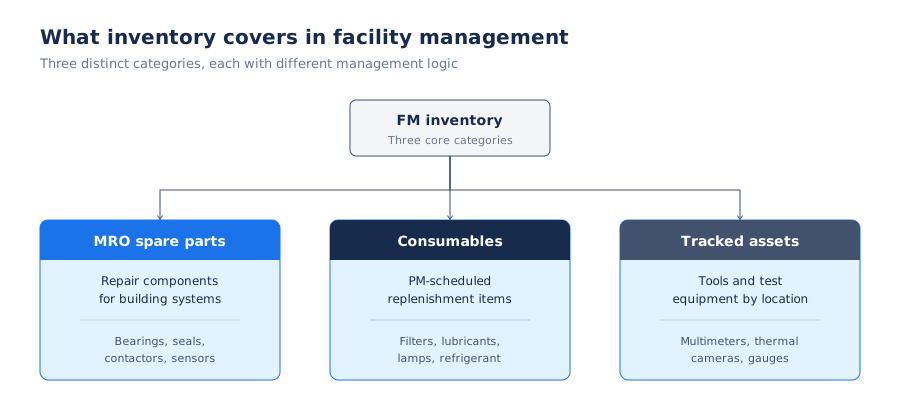
MRO Spare Parts (Maintenance, Repair, Operations)
These are the components used to repair or maintain building systems: bearings, belts, seals, contactors, fuses, sensors. They're transactional, consumed when a work order closes, and their criticality varies wildly. A spare pump bearing for a primary chilled water loop is mission-critical. A replacement ceiling tile is not.
Consumables
Filters, lubricants, cleaning supplies, refrigerant, lamps. These move on predictable schedules tied to your Preventive Maintenance (PM) programme. A 500,000 sq. ft. office portfolio running AHU filter changes every 90 days has a quantifiable, forecastable consumption rate. The math is known; the failure is usually in tracking it.
Assets and Equipment
Tools, testing instruments, portable equipment (thermal cameras, multimeters, power analysers). These aren't consumed, they're tracked. Asset inventory management governs location, condition, calibration status, and lifecycle. A technician checking out a fluke meter at Site A shouldn't mean Site B has no meter for the next two weeks.
Why Traditional Inventory Management Breaks Down at Scale
A single-site FM team with a well-organised parts room and a sharp storekeeper can get by on spreadsheets and institutional knowledge. The moment you add a second site, the model starts to crack. By the fifth site, it's chaos.
Here's what actually happens:
- Siloed stock across locations. Site A is overstocked on HVAC filters. Site B just ran out. No one knows. Both sites ordered independently last month.
- No linkage between work orders and stock consumption. A technician pulls parts, completes the job, and forgets to update the sheet. Stock records drift from physical reality within weeks.
- Reactive procurement. Parts are ordered when someone notices they're missing, not when a defined minimum threshold is crossed. Lead time becomes part of your downtime.
- No criticality logic. Fast-moving, low-criticality items get the same attention as slow-moving, critical ones. Storage costs climb. Stockouts still happen on the parts that matter most.
The common thread: inventory managed outside the maintenance workflow will always be inaccurate.
How CMMS-Driven Inventory Management Works
A Computerised Maintenance Management System (CMMS) doesn't just log work orders; it connects the maintenance workflow to inventory in real time. Here's the technical architecture of how that works.
Item Catalogue and Stock Locations
Every spare part and consumable is catalogued with a unique item ID, description, unit of measure, and one or more stock locations (store rooms, site warehouses, mobile vans). Multi-site operations define a location hierarchy: central warehouse → site storeroom → technician van stock.
Reorder Rules: Min/Max Logic
Each item carries a minimum stock level (the reorder trigger) and a maximum stock level (the replenishment ceiling). When stock drops below the minimum, either through manual withdrawal or automatic consumption on work order closure, the system generates a purchase requisition automatically.
The minimum level isn't arbitrary. It's calculated from:
- Average daily consumption rate
- Supplier lead time
- Safety stock buffer (typically 1–2x lead time demand for critical items)
For a critical spare like a chiller compressor contactor with a 7-day lead time and an average consumption of 1 unit/month: minimum stock = 1 unit, maximum = 3 units. Simple. But it has to be in the system to work.
Work Order Consumption: The Critical Link
This is where most FM teams either get it right or stay broken. When a technician closes a corrective work order for a bearing replacement, the CMMS should auto-deduct the consumed parts from the relevant stock location. No manual update. No clipboard.
This single integration, work order → stock deduction, is what keeps inventory records accurate over time. Without it, your stock data degrades within 30 days of going live.
Criticality Classification: A/B/C Tiering
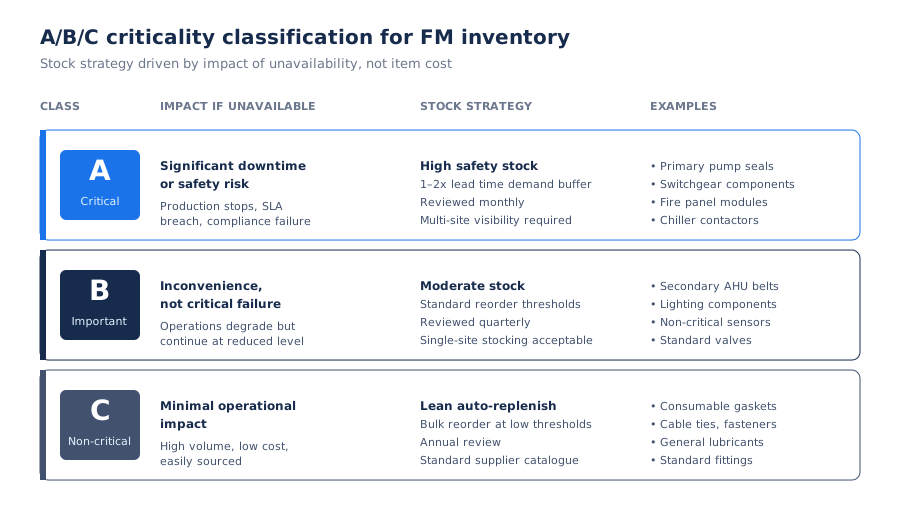
Not all parts should be stocked the same way. A criticality-based classification system (often called ABC analysis) separates inventory into:
- A-class (Critical): Parts whose unavailability causes significant downtime or safety risk. High safety stock. Reviewed monthly. Examples: primary pump seals, main switchgear components, fire panel modules.
- B-class (Important): Parts that cause inconvenience but not critical failure. Moderate stock. Examples: secondary AHU belts, general lighting components.
- C-class (Non-critical): High-volume, low-cost items. Lean stock. Auto-replenish. Examples: consumable gaskets, cable ties, standard fasteners.
Stocking everything like it's A-class wastes capital. Stocking A-class items like C-class creates downtime. The classification is the strategy.
Real-World FM Scenarios
Scenario 1: PM-Linked Consumable Forecasting
A facility management company operates 12 commercial buildings across three cities. Each building runs quarterly AHU filter replacements as part of its PM schedule. In a CMMS with inventory integration, the PM work orders auto-reserve the required filter quantities from stock 30 days before the scheduled date. If stock is insufficient, a purchase requisition is triggered automatically. The result: filter stockouts on PM days drop to zero. Lead time is absorbed in advance, not scrambled for at the last minute.
Scenario 2: Critical Spare Parts and Mean Time to Repair
A corporate campus FM team tracks MTTR (Mean Time to Repair) for their chiller plant. Historical data shows that 40% of corrective work orders for chiller faults are delayed by parts unavailability, not technician availability. By running a criticality analysis on their top 20 chiller-related work orders over 12 months, they identify 8 high-frequency spare parts responsible for 70% of delays. Stocking those 8 items at A-class levels cuts average chiller-fault MTTR from 18 hours to 6.
Scenario 3: Multi-Site Stock Visibility
A portfolio FM company managing 20+ buildings used to run each site's inventory independently. Central procurement had no visibility into site-level stock. Over-purchasing was rampant. When an urgent repair hit Site 7, no one knew that Site 3 had the part sitting on a shelf 12 km away.
With a centralised CMMS inventory module, the central procurement team now sees consolidated stock across all locations. Inter-site transfers are logged as stock movements. Emergency procurement only kicks in when the entire network is genuinely out of stock, not just one site.
Asset Inventory vs. Spare Parts Inventory: The Distinction That Matters
These two are often conflated but serve different functions.
Asset inventory is your equipment register, every maintainable asset tagged, located, and tracked through its lifecycle. An asset has a condition, an age, a maintenance history, and an eventual replacement date. Asset inventory management feeds your capital expenditure planning.
Spare parts inventory is transactional, items consumed in the course of maintaining those assets. The relationship between the two is where the real intelligence lives: an asset's failure history tells you which spare parts to stock, at what quantity, and at what criticality level.
A 10-year-old chiller with a history of compressor contactor failures should drive a higher safety stock on that component than a 2-year-old unit with a clean service record. The asset register informs the stocking strategy.
Inventory KPIs That Actually Tell You Something
Tracking inventory performance requires metrics that connect to maintenance outcomes, not just warehouse tidiness.
- Stockout rate: Percentage of work orders delayed due to parts unavailability. Target: <5% for A-class items.
- Inventory turnover ratio: How many times your average stock is consumed and replenished in a year. Low turnover = dead stock. High turnover on critical items without safety stock = risk.
- Carrying cost as % of asset value: The cost of holding inventory (storage, insurance, obsolescence). Signals when overstocking is costing more than it's saving.
- Parts consumption per asset: Tracks which assets are consuming disproportionate spare parts spend, an early signal for replacement decision-making.
- Procurement lead time vs. MTTR: If your average lead time for critical parts exceeds your target MTTR, your safety stock calculation is wrong.
Where Connected Building Platforms Change the Equation
Traditional CMMS inventory management is reactive by design; it responds to consumption. The next step is predictive inventory: stock decisions driven by real-time asset health data rather than historical averages.
When a building platform like IQnext connects IoT sensors to asset monitoring, it generates live condition data , vibration signatures on rotating equipment, operating temperatures on electrical panels, runtime hours on critical systems. That data, fed into maintenance workflows, allows facilities teams to anticipate failures before they occur and pre-position the right spare parts before the work order is even raised.
The result isn't just fewer stockouts. It's a fundamentally different relationship between maintenance planning and inventory management, one where the building tells you what it needs before it breaks.
The Bottom Line
Inventory management in facility management is an operational discipline, not a warehouse problem. When it's integrated into your CMMS, connected to your work order workflows, and structured around criticality logic, it stops being reactive and starts being a genuine competitive advantage, lower MTTR, predictable costs, and maintenance teams that spend their time fixing buildings rather than chasing parts.
The technology to do this well exists. The question is whether your current FM system is set up to use it.
FAQs
1. What is inventory management in facility management?
Inventory management in facility management is the process of tracking, controlling, and replenishing the spare parts, consumables, and tools required to maintain building systems and assets. It covers MRO (Maintenance, Repair, and Operations) spare parts, consumables like filters and lubricants, and tracked equipment — all managed in coordination with work orders and preventive maintenance schedules to minimise downtime and procurement delays.
2. How does a CMMS help with inventory management?
A CMMS improves inventory management by linking stock directly to work orders — automatically deducting consumed parts when a job closes, triggering purchase requisitions when stock drops below a defined minimum level, and giving multi-site teams a single view of stock across all locations. This eliminates manual tracking errors and ensures procurement is driven by real consumption data, not guesswork.
3. What are the most important inventory management KPIs for facility managers?
The key inventory KPIs for facility managers are stockout rate (percentage of work orders delayed due to missing parts), inventory turnover ratio, carrying cost as a percentage of asset value, parts consumption per asset, and procurement lead time compared against target MTTR. Together, these metrics reveal whether inventory strategy is reducing maintenance downtime or quietly adding to it.