

.png)
Breakdown maintenance is the only maintenance strategy that requires zero upfront investment. No PM schedules to build. No sensors to install. No software to procure. Just wait for something to fail, then fix it.
For a single light fixture or a minor plumbing fitting, that logic is perfectly rational. For the chiller plant cooling a 400,000 sq. ft. office tower, it's the most expensive decision a facilities team can make; it just never shows up that way on a single report.
The repair invoice is visible. Everything it triggers - the overtime, the expedited parts, the shortened asset life, the tenant who remembers an uncomfortable week when their lease comes up is scattered across budget lines that no one adds together. That's what makes breakdown maintenance so persistent. It doesn't look expensive until you do the math.
This blog does the math.
What Is Breakdown Maintenance?
Breakdown maintenance, also called reactive maintenance or run-to-failure maintenance, is work performed only after an asset has stopped functioning. There's no schedule, no condition monitoring, no planned intervention. The asset runs until it fails, then a technician is dispatched to restore it.
In a commercial facility, this looks like a chiller compressor seizing on a summer afternoon, a fire panel throwing an undiagnosed fault during a tenant audit, or a lift motor failing during peak hours. The common thread: no warning, no preparation, and no time to source parts or labour at standard rates.
Breakdown maintenance isn't always the wrong choice. For low-criticality, low-cost assets - a single light fixture, a minor tap fitting, a standard gasket - the cost of prevention genuinely exceeds the cost of replacement. Running to failure is the rational call.
The problem starts when this becomes the default for everything, including the critical building systems where a single failure triggers a cascade of costs that the repair invoice alone will never capture. For a deeper look at how breakdown maintenance fits within the broader maintenance spectrum, see our guide to repair and maintenance in facility management.
Why Breakdown Maintenance Looks Cheap (But Isn't)
The appeal of breakdown maintenance is straightforward: no scheduled downtime, no maintenance software, no PM programme to design and staff. On paper, it looks like the leanest possible operating model. Nothing is spent until something breaks.
But the cost structure is entirely back-loaded. Every rupee not spent on prevention is borrowed against a future emergency, with interest. When a critical asset fails without warning, the FM team doesn't get to choose the timing, the technician, the vendor, or the price. All four are dictated by the urgency of the failure.
A planned bearing replacement on a chilled water pump costs a predictable amount: standard labour, standard parts pricing, scheduled during low-occupancy hours. The same bearing replaced as an emergency after the pump seizes costs 2–3x more when you add overtime labour, expedited parts, and the operational disruption in between.
This is the reactive tax - a recurring surcharge paid by every FM operation that hasn't shifted its critical assets to planned maintenance. It doesn't appear as a line item on any report. It's embedded in inflated labour invoices, premium vendor rates, and capex budgets that arrive earlier than they should. The longer a portfolio runs on breakdown maintenance as its default mode, the higher the tax compounds.
The Five Hidden Costs of Breakdown Maintenance
The repair invoice is the cost everyone sees. These five are the ones they don't.

Emergency Labour Premiums
Breakdown maintenance rarely respects business hours. After-hours call-outs, weekend rates, and overtime premiums run 1.5x to 2.5x standard labour costs. A chiller trip on a Friday evening doesn't just cost a technician's time; it costs that time at the most expensive rate available. One critical failure outside working hours can cost more in labour alone than a full quarter of planned servicing on the same asset.
Expedited Parts and Procurement
When an asset is down and the part isn't in stock, normal procurement rules disappear. No competitive sourcing. No bulk pricing. No lead-time planning. Emergency vendor markups can inflate part costs by 30–50% over standard procurement pricing. The teams that maintain strong spare parts management avoid this category almost entirely. See Inventory Management.
Accelerated Asset Degradation
Running equipment to failure shortens its useful life. A chiller compressor that operates under strain for days before a seal replacement loses operating hours that don't come back. A motor forced to run through a bearing fault degrades components that weren't part of the original failure. Across a portfolio, this shows up as earlier-than-expected capital replacement cycles, assets rated for 15 years getting replaced at year 11 or 12.
SLA Breaches and Tenant Impact
The penalty clause is the visible cost. The invisible cost is what happens at lease renewal. A tenant whose office was uncomfortably warm for three days in peak summer, or whose elevator was out of service for a week, carries that memory into the renewal conversation. Tenant churn driven by poor building experience is a cost that never appears on a maintenance report, but it's often the largest one.
Energy Waste from Degraded Performance
Equipment running outside its design envelope consumes more energy. Clogged filters increase fan energy consumption. Fouled condenser coils force compressors to work harder. Poorly maintained HVAC systems can waste 15–30% of the energy they consume. Across a 20-building portfolio, that's lakhs in avoidable electricity spend compounding every single month.
When Breakdown Maintenance Is the Right Call
Not every asset justifies a preventive programme. Breakdown maintenance is a rational strategy when four conditions are true simultaneously:
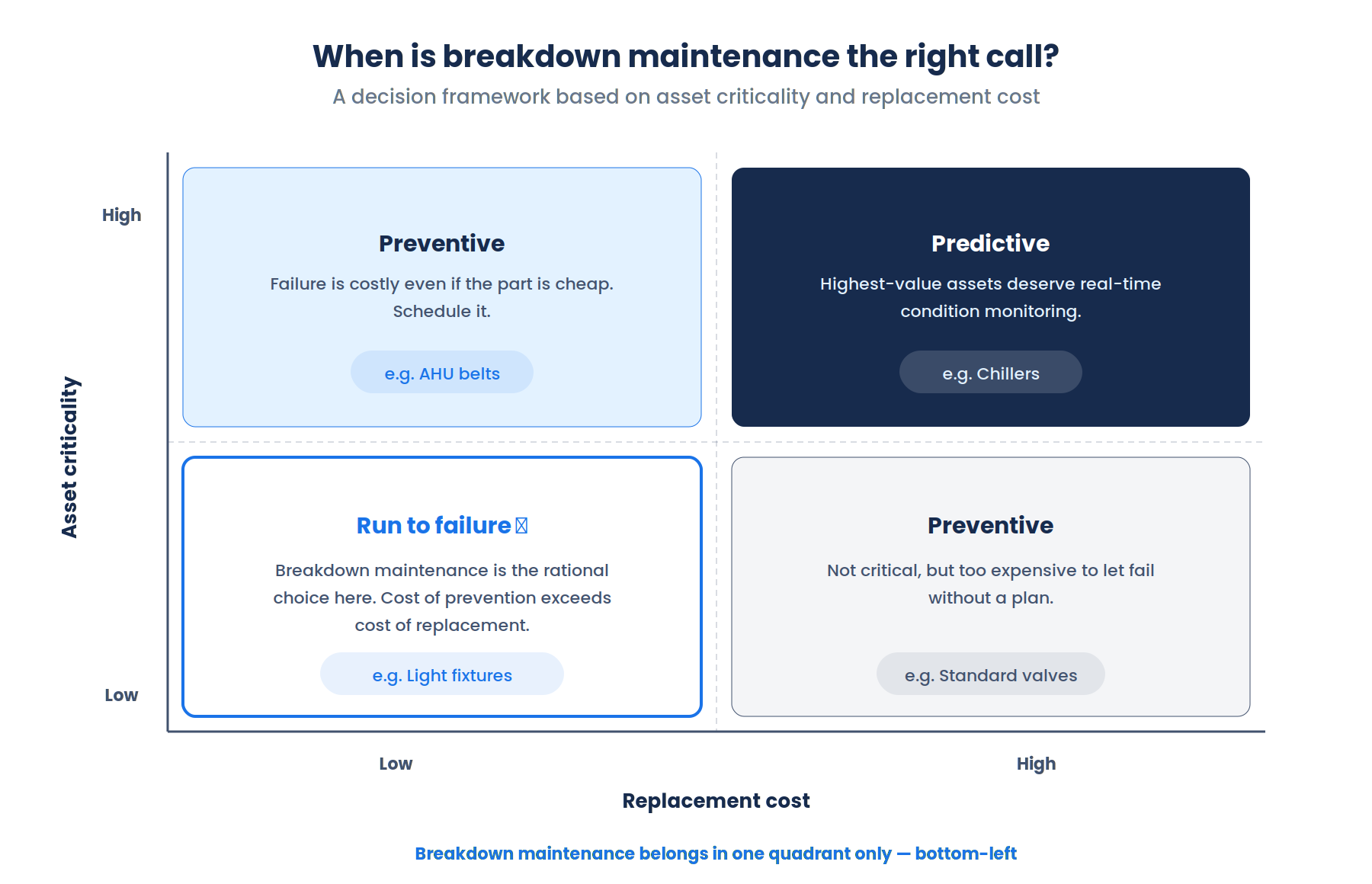
Low criticality. Failure doesn't disrupt building operations, compromise safety, or affect tenant experience. Nobody evacuates over a dead light fixture.
Low replacement cost. The part or asset is cheaper to replace on failure than to inspect and maintain on a schedule. A standard gasket costs less to replace than the technician hours needed to inspect it quarterly.
No downstream impact. The failure doesn't cascade, it doesn't strain adjacent equipment, trigger secondary faults, or degrade system-level performance.
Easy sourcing. The replacement part is readily available. No lead-time risk, no specialist vendor, no emergency procurement premium.
Examples that pass all four: individual light fixtures, minor plumbing fittings, standard fasteners, non-critical gaskets and seals.
Examples that fail at least one: chillers, switchgear, fire panels, elevators, primary pumps, AHUs. For these assets, a single unplanned failure triggers costs across all five categories in the previous section, labour, parts, asset life, tenant impact, and energy. Breakdown maintenance on critical building systems isn't a cost-saving strategy. It's a deferred expense with compounding interest.
The decision framework is simple: if the total cost of an unplanned failure is lower than the cost of preventing it, run to failure. For everything else, plan.
How to Move Off Breakdown Maintenance
The shift isn't a single decision. It's a three-stage progression, and it starts with knowing what you have, not buying what you think you need.
Stage 1: Visibility.
Build an asset register. Every maintainable asset tagged with a unique ID, location, make, model, installation date, and criticality classification. Then pull 12 months of work order history and sort by cost. The assets that consumed the most in emergency repairs last year are your starting point, not a vendor's feature list.
Stage 2: Planning.
Shift high-criticality assets onto preventive schedules first. Set a Planned Maintenance Percentage target above 80% and track it monthly by site. The goal isn't to eliminate breakdown maintenance entirely, it's to confine it to the assets where it's the rational choice, not the ones where it's the expensive default.
Stage 3: Intelligence.
For high-value, high-criticality asset, primary chillers, main switchgear, critical pumps, calendar-based prevention is a step forward but not the destination. The next step is condition-based maintenance: real-time sensor data replacing fixed schedules.
This is where platforms like IQnext change the equation. By connecting building systems through an IoT gateway and streaming live asset health data into a centralised dashboard, IQnext gives facilities teams the visibility to move beyond schedules entirely, maintaining assets based on what they actually need, not what the calendar says. Across a portfolio, that shift turns breakdown maintenance from the default operating mode into a deliberate, bounded decision.
The Most Expensive Strategy That Looks Free
Breakdown maintenance isn't free. It's deferred cost with compounding interest. The repair invoice is the visible fraction. The real cost is buried in overtime, shortened asset lives, lost tenants, and wasted energy, scattered across budget lines that no one adds together until the number is already too large to ignore.
For portfolio operators running critical building systems on a reactive default, every month in that mode is a month of avoidable financial exposure. The buildings that cost the least to operate won't be the ones that fixed the most. They'll be the ones that broke the least.
FAQs
1. What is breakdown maintenance?
Breakdown maintenance is work performed only after an asset has failed. Also called reactive or run-to-failure maintenance, it involves no scheduled servicing or condition monitoring, the equipment runs until it stops, then a technician is dispatched to repair it.
2. What is the difference between breakdown maintenance and preventive maintenance?
Breakdown maintenance repairs equipment after failure. Preventive maintenance services equipment on a fixed schedule before failure occurs. Preventive costs more upfront but significantly reduces emergency labour, expedited parts procurement, and unplanned downtime over time.
3. Why is breakdown maintenance expensive?
The repair invoice is only a fraction of the true cost. Hidden costs include emergency labour premiums, expedited parts at 30–50% markups, shortened asset lifespan, SLA breaches, and energy waste from equipment running outside its design envelope.
4. When is breakdown maintenance the right choice?
Breakdown maintenance is rational when an asset is low-criticality, low-cost to replace, has no downstream impact on other systems, and its replacement parts are easily sourced. Common examples include individual light fixtures, minor plumbing fittings, and standard gaskets.
5. How can facility managers reduce breakdown maintenance?
Start by building an asset register and identifying which assets cost the most in emergency repairs. Shift high-criticality assets onto preventive schedules first, targeting a Planned Maintenance Percentage above 80%, then move to condition-based maintenance for high-value equipment.
.png)


