

.png)
Here is a number worth pausing on: 84% of facilities management leaders globally cite budget constraints and escalating operating costs as their top concern, according to JLL's Global State of Facilities Management Report. At the same time, 55.7% of facility managers expect their work order volume to increase year over year. More work, less money, and higher expectations - that is the reality of the role in 2026.
Yet for all the operational weight it carries, facility management remains one of the most misunderstood functions in any organisation. Ask someone outside the field what a facility manager does and you will likely hear 'building maintenance.' The reality is far broader, far more strategic, and increasingly, far more dependent on technology to execute well.
This guide breaks down what facility manager responsibilities actually look like in 2026 - the full scope, the real challenges, and what separates the FMs who are thriving from those who are perpetually firefighting.

What Does a Facility Manager Actually Do?
A facility manager is responsible for everything the business takes for granted - the lights that turn on, the HVAC that keeps the floor comfortable, the vendor who showed up on time, the compliance audit that passed without incident, and the energy bill that came in under budget.
The role sits at the intersection of operations, finance, compliance, and workplace experience. It is both deeply technical and intensely people-facing. And unlike most functions, facility management does not get to have a bad day quietly - when something goes wrong, everyone notices immediately.
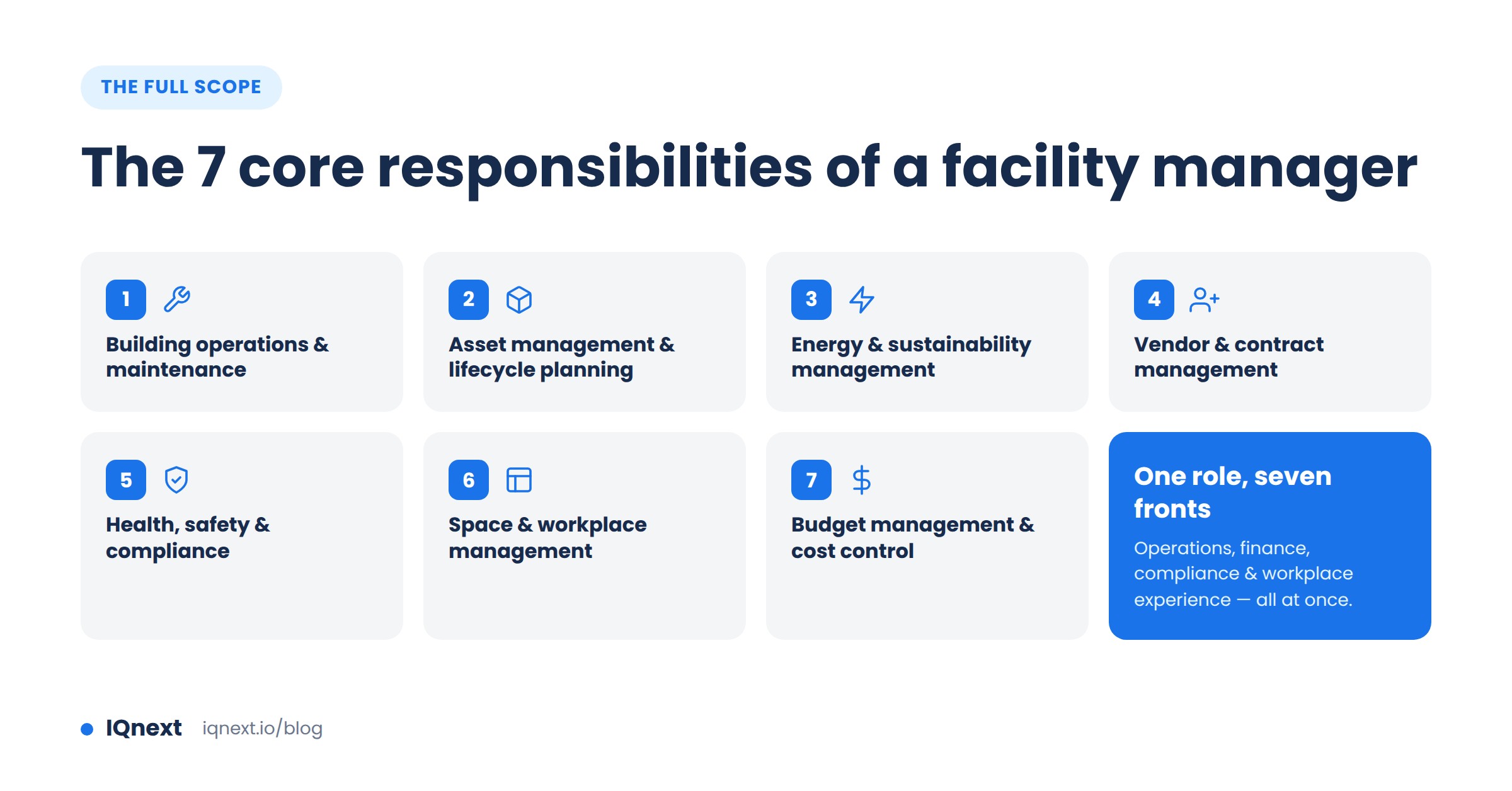
The 7 Core Responsibilities of a Facility Manager
1. Building Operations and Maintenance
This is the most visible part of the role and the one that never stops. Facility managers oversee the day-to-day functioning of every physical system in the building: HVAC, electrical, plumbing, elevators, fire suppression, lighting, and more. When any of these systems fail, the FM is the first call.
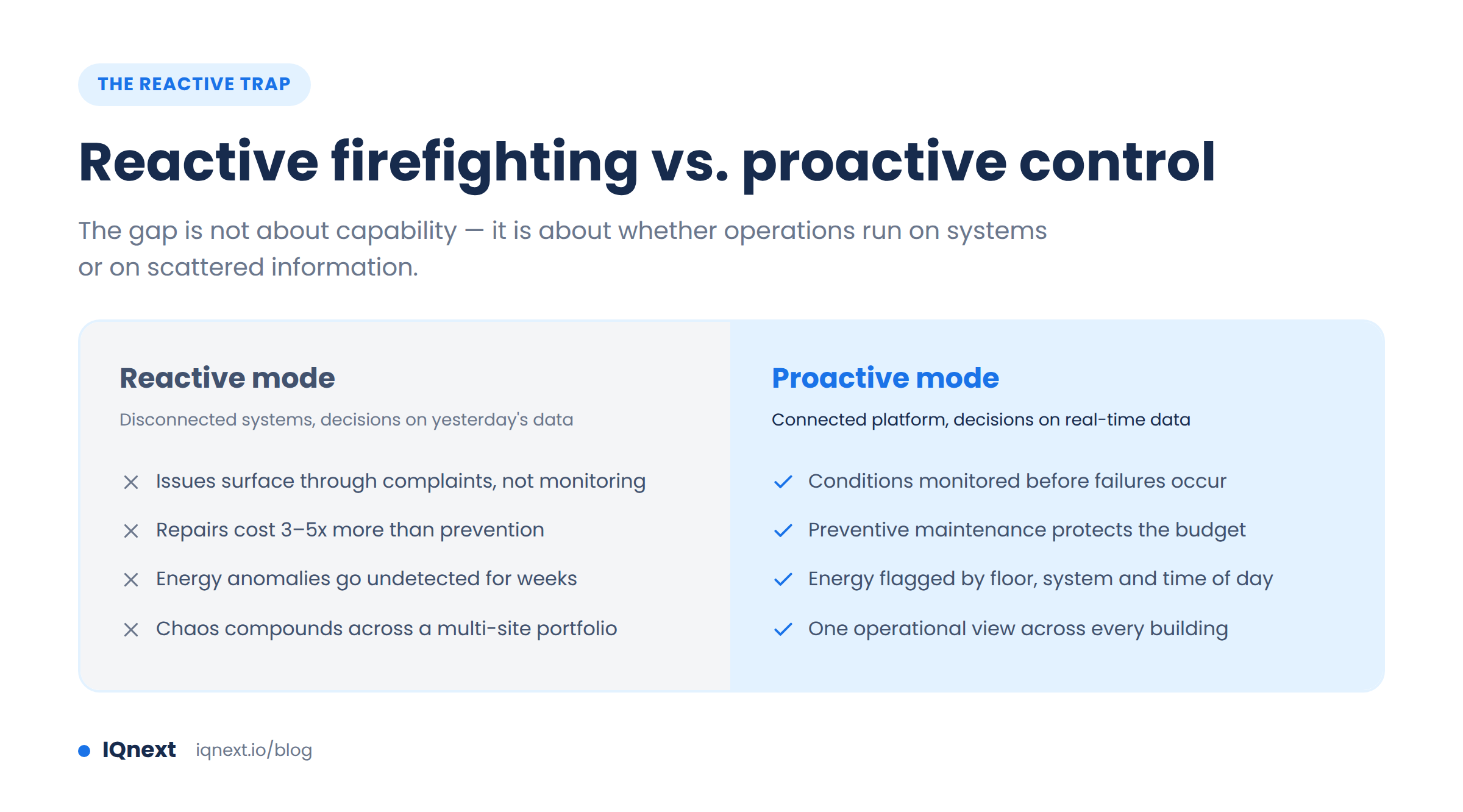
The distinction that matters most here is the difference between preventive and reactive maintenance. Preventive maintenance - scheduled inspections, routine servicing, condition-based monitoring - is what good facility management looks like. Reactive maintenance - fixing things after they break - is what it looks like when preventive maintenance has not been prioritised or resourced.
The cost gap between the two is significant. Reactive repairs consistently run three to five times more expensive than preventive interventions, and they come with the added cost of operational disruption.
With work order volumes rising year over year, facility managers who rely on manual tracking and spreadsheet-based scheduling are falling further behind.
2. Asset Management and Lifecycle Planning
Every piece of equipment in a building has a lifecycle - a point at which it needs servicing, upgrading, or replacing. Managing that lifecycle intelligently is one of the most financially consequential responsibilities a facility manager carries.
The challenge in 2026 is significant: across the industry, the average age of fixed assets has been climbing for years, leaving facility managers to extend the life of ageing infrastructure while simultaneously managing tighter capital budgets.
This requires more than maintenance schedules. It requires asset data - real-time visibility into equipment condition, utilisation, and failure history - to make defensible decisions about when to repair versus when to replace. Without that data, capital investment planning is largely guesswork.
3. Energy and Sustainability Management
Energy management has moved from a cost-control function to a strategic priority. ESG reporting mandates, sustainability targets, and rising energy costs have placed facility managers at the centre of their organisation's carbon reduction commitments.
The problem is that most facilities are still flying blind on energy. Real-time consumption monitoring is one of the most consistently cited gaps in FM operations - organisations know they are spending too much on energy but lack the granular visibility to identify where and why.
IoT-connected building management systems change this equation entirely. When energy meters, HVAC systems, and lighting controls are connected to a central platform, facility managers can monitor consumption by floor, by system, and by time of day - and act on anomalies before they compound into waste.
4. Vendor and Contract Management
A facility rarely runs on internal resources alone. Cleaning services, security, landscaping, specialist maintenance contractors, equipment suppliers - the average commercial facility manages dozens of external service relationships simultaneously.
The facility manager's responsibility is to ensure every one of those relationships delivers what was contracted, at the standard agreed, within the budget allocated. This means negotiating service level agreements, monitoring performance against those agreements, and holding vendors accountable when they fall short.
The hidden cost of poor vendor management is significant. Fragmented contracts, duplicated services, and lack of performance visibility lead to budget leakage that is difficult to quantify but easy to prevent with structured oversight.
5. Health, Safety, and Compliance
Compliance has fundamentally changed in character. Where it was once a matter of periodic audits and annual certifications, regulatory requirements in 2026 operate as continuous obligations. Fire safety systems must be tested on schedule. Indoor air quality must meet defined standards. Accessibility requirements must be maintained. Documentation must be current and retrievable at any point.
For multi-site facility managers, the compliance burden multiplies with every building added to the portfolio. Keeping a consistent compliance standard across ten locations - each with its own inspection schedules, contractors, and local regulatory requirements - is operationally demanding without systems to track and automate the process.
6. Space and Workplace Management
How a building's space is allocated and utilised has a direct impact on employee productivity, real estate costs, and organisational agility. Facility managers are responsible for ensuring that space is being used efficiently - not just in theory, but in practice, based on actual occupancy data.
CBRE's 2026 Global Workplace and Occupancy Insights report found that organisations with structured, real-time utilisation data make faster, cheaper, and more accurate space decisions than those relying on surveys or manual observation. The difference shows up in decisions about lease renewals, floor reconfiguration, and hybrid work policy design.
Space management has become more complex with the normalisation of hybrid work. Desk booking, meeting room utilisation, team clustering - these decisions now require data that most legacy facility management setups were never built to collect.
7. Budget Management and Cost Control
According to the SFG20 State of Facilities Management Report 2025, 75% of FM teams cite budget constraints as their primary operational challenge. A further 40% absorbed budget cuts between 2024 and 2025 - even as operational demands increased.
The facility manager's job is not simply to cut costs. It is to spend what is available as intelligently as possible - directing maintenance spend toward the assets and systems that most need it, identifying energy savings that fund other priorities, and building a credible case for capital investment when it is genuinely needed.
That case is only credible when it is backed by data. Budget conversations built on spreadsheet estimates and gut feel rarely win. Those built on asset condition reports, energy consumption trends, and maintenance cost histories do.
Why Most Facility Managers Are Stuck in Reactive Mode
There is a trap that catches even experienced facility managers, and it has nothing to do with capability. It has to do with the tools and systems they are given to work with.
When facility operations run on disconnected systems - maintenance tracked in one spreadsheet, energy data in another, vendor contracts in email threads, compliance records in physical folders - every day becomes an exercise in information retrieval rather than decision-making. Issues surface through complaints, not monitoring. Decisions get made on yesterday's data. Planning becomes difficult when the operational present is already consuming all available attention.
This is the reactive trap. And it compounds at scale.
Managing one building manually is hard but manageable. Managing ten buildings the same way is not - it is chaotic. Work orders pile up across sites. Energy anomalies go undetected for weeks. Compliance deadlines get missed at locations where the local team is understaffed. Vendor performance varies and nobody has a consolidated view of it.
This is the portfolio-scale problem that defines modern facility management - and it is the problem that manual processes and siloed legacy systems simply cannot solve, regardless of how capable the people using them are.
How Technology Is Reshaping the Facility Manager Role
The shift is already well underway. According to Johnson Controls' 2026 AI and Digitalization in Facilities Management Report - which surveyed 760 business leaders and 260 facility managers - 85% of organisations now use workplace management solutions. Technology adoption in FM is no longer a differentiator. It is becoming baseline.
But adoption has created a new problem: integration. One-third of business leaders in the same report cited ease of integration as what they would most like to change about their current workplace management systems. For facility managers specifically, data quality and integration gaps are the biggest barriers to scaling technology investments - ahead of budget constraints and cybersecurity concerns.
The implication is clear. It is not enough to have a CMMS for maintenance, a separate BMS for building systems, and another tool for energy monitoring. When these systems do not talk to each other, facility managers are still left piecing together the picture manually - just with more expensive software.
The platforms that are genuinely changing how facility managers work are those that consolidate these functions - connecting building devices, maintenance workflows, energy data, and space utilisation into a single operational view. Platforms like IQnext are built specifically for this: integrating existing building systems over standard protocols like BACnet and Modbus, and surfacing portfolio-level intelligence through a centralised cloud dashboard, whether you are managing three buildings or seventy-five.
The Facility Manager of 2026: From Caretaker to Operational Strategist
The title has not changed, but the role has.

The facility managers who are gaining strategic influence in their organisations are not the ones who respond fastest to equipment failures. They are the ones who present energy savings with data. Who make capital investment cases with asset condition reports. Who walk into board conversations with occupancy utilisation numbers that inform real estate decisions.
That shift - from operational responder to data-driven strategist - is only possible when the operational layer is handled by systems rather than people. When work orders are automated, energy anomalies are flagged in real time, and compliance schedules run without manual tracking, the FM's bandwidth moves from firefighting to forward planning.
The buildings that work best in 2026 are not the ones with the most advanced equipment. They are the ones with the most connected, most visible, and most intelligently managed operations. The facility managers running those buildings are not just keeping the lights on. They are making the business case for how the physical environment drives organisational performance.
That is a different conversation entirely - and it is one worth having.
FAQs
1. What are the main responsibilities of a facility manager?
A facility manager is responsible for building operations and maintenance, asset lifecycle management, energy and sustainability monitoring, vendor and contract management, health and safety compliance, space and workplace planning, and budget management. The role spans both day-to-day operational tasks and long-term strategic planning.
2. What is the difference between hard and soft facility management?
Hard facility management covers the physical and technical infrastructure of a building - HVAC, plumbing, electrical, structural maintenance, and other systems that are permanently attached to the building. Soft facility management covers the services that support the people using the building - cleaning, security, catering, landscaping, and reception. Many organisations now adopt an integrated facility management approach that coordinates both under a single operational framework.
3. What tools do facility managers use to manage their work?
Modern facility managers rely on a combination of CMMS (Computerised Maintenance Management Systems) for maintenance and work order management, BMS (Building Management Systems) for real-time monitoring and control of building systems, and integrated platforms that connect both alongside energy management, space utilisation, and compliance tracking. The shift toward connected, cloud-based platforms is accelerating as organisations recognise the operational cost of managing these functions through disconnected tools.
Managing a portfolio of buildings and looking for a single platform to connect your devices, maintenance workflows, and energy data? Explore how IQnext works.

.png)
.png)
